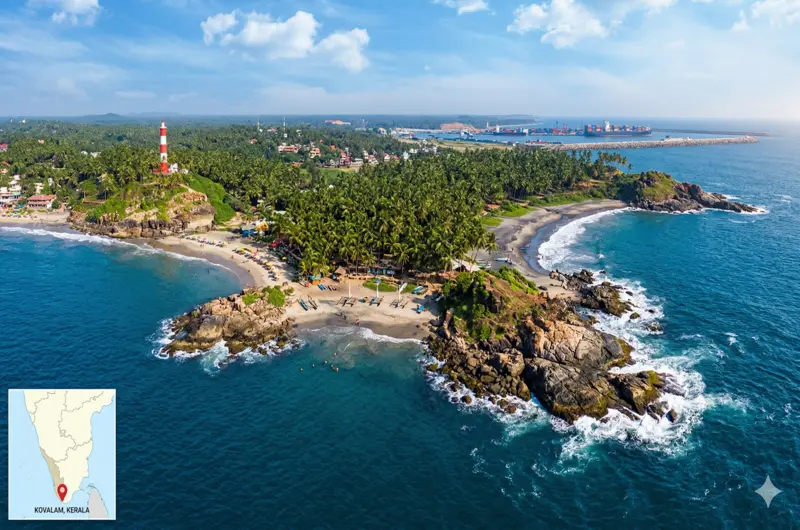
The Geographical Importance and Location of Kovalam: An Expanded Guide
Situated in the Indian state of Kerala, Kovalam is basically a beach town where tourists can enjoy a glimpse of the deep blue Arabian Sea. This iconic destination is located at a distance of 16 km from Thiruvananthapuram city, the capital of the state. The geographic location of this place has actually made it an exquisite as well as unique tourist destination, drawing millions of visitors to its shores annually.
The defining characteristic of Kovalam’s geography is its triple-crescent coastline. The beach town has three major beaches which are separated by massive rocky outcroppings or promontories. These natural barriers not only provide a stunning visual hierarchy but also create calm, shallow bays that are ideal for swimming and maritime activities.
1. Lighthouse Beach: The Southern Landmark
Lighthouse Beach is the most popular beach of Kovalam and is also the largest among the three. Most tourists visit this beach, and it is often found crowded with travellers from different parts of the world.
Due to the location of the 35-meter-high old Vizhinjam Lighthouse, this southernmost beach of Kovalam is aptly named Lighthouse Beach. The structure sits atop the Kurumkal hillock, a rocky promontory that provides a natural vantage point over the Arabian Sea. Light beams from the old lighthouse provide an unearthly charm to the beach at night, while during the day, the lighthouse offers a panoramic view of the coastline that stretches toward the horizon.
Geographical Significance of Lighthouse Beach:
- Height: The lighthouse stands 35 meters tall, offering a 360-degree view.
- Tides: The presence of the rocky headland creates a sheltered bay, making the water here relatively calm compared to the open sea.
- Connectivity: It is the most accessible point for tourists coming from the southern parts of the district
2. Hawah Beach (Eve’s Beach): The Hub of Life
Hawah Beach, which is also known as Eve’s Beach, is located right beside the Lighthouse Beach. While this beach is visited by tourists often, it is mainly dedicated to the local fishermen.
Fishing is one of the greatest sources of earning for the people of Kovalam, and this beach serves as a vital landing site for their catch. The beach experiences a slightly lower number of tourists than Lighthouse Beach, which is why this place is suitable for those who are in search of serenity or peace.
A Storied History and Unique Fauna:
Hawah Beach, the second largest among the beaches of Kovalam, has its name derived from the presence of European women who frequented the area decades ago. Although topless bathing is strictly banned in India today, a few decades earlier, it was a topless beach—in fact, it was the first topless beach in India.
From a biological perspective, this beach attracts a vast number of birds during different seasons. An array of wild animals and marine life can be explored here, primarily water-living animals and migratory birds that thrive in the calm, nutrient-rich coastal waters.
3. Samudra Beach: The Secluded North
Samudra Beach is completely separated from the other two major beaches of Kovalam through a large promontory. Because of this geographical isolation, the beach experiences a significantly lower number of tourists in comparison to the others.
Like Hawah Beach, it is a dedicated spot for the fishing business. You will often find local fishermen arranging their boats (catamarans) to go for a fishing voyage. Geographically, Samudra Beach is the most "stable" part of the coast, with less commercial development, allowing the natural coconut groves to grow right up to the high-tide line.
4. Ashoka Beach and the Virgin Coastline
Apart from these three major beaches, there are a few other smaller beaches present in Kovalam. One of the most famous amongst them is Ashoka Beach.
Located at the northern part of Kovalam, this virgin or untouched beach provides exquisite views of nature along with a complete aura of serenity. Geographically, this area is characterized by shallow sea water launching upon the beach rocks and creating amazing splashes—a favourite sight for photographers and nature lovers.
How to reach Ashoka Beach:
- By Foot: Tourists can choose to take a scenic walk from Samudra Beach.
- By Road: Alternatively, local transport and car services are available to take tourists to the northern reaches of the town.
5. The Science of the "Black Sands"
Due to its unique geographic location and climate, the sands of the beaches of Kovalam are neither golden nor white. Instead, they are partially blackish in colour.
This is a significant geological feature caused by the presence of Ilmenite and Monazite. Because of these heavy minerals, the sand appears a bit blackish, particularly after a high tide. These minerals are washed down from the Western Ghats and are concentrated on the Kovalam coast due to the specific wave energy and the sheltering effect of the rocky promontories.
6. Regional Context: Proximity to Thiruvananthapuram
Kovalam's location just 16 km from the capital makes it a critical part of the regional ecosystem.
- Climate: The town experiences a tropical climate, with heavy rainfall during the Southwest Monsoon (June–August).
- Vegetation: The name "Kovalam" itself means "a grove of coconut trees," highlighting the dense palm forests that define the landward geography of the area.
- Geographical Landmarks: To the south lies the Vizhinjam Port, which is currently being developed into a major international transshipment hub, further increasing the strategic importance of Kovalam's location.
7. Why Geography Matters for Tourism
The unique geographic location of Kovalam is the primary reason for its success as a global resort. The rocky promontories act as natural "sea walls," protecting the beaches from heavy erosion while creating the iconic "crescent" shapes that allow for safe swimming. This combination of calm waters, mineral-rich sands, and accessible headlands makes Kovalam a textbook example of coastal beauty.
Kovalam is more than just a place to sunbathe; it is a geographical marvel. From the 35-meter-high vantage point of the Lighthouse to the secluded, rock-strewn shores of Ashoka Beach, the physical layout of this town offers something for every traveller. The blend of Ilmenite-rich sands, volcanic rock outcroppings, and a 16 km proximity to the capital ensures that Kovalam remains the most strategically and aesthetically significant beach town in Kerala.
0 Comments
Post Comment